CHAUCER BY CANDLELIGHT

after Caroline Bergvall


              the martyr
of twenty year of age he was, i guess
 
the heap of bodies dead    and many a bloody wound
 
tyranny that cause is of his murder
that in his house was by his servants slain
 
              man is slain like any other beast
and dwells in prison and arrest
              and often guiltless
 
what governance is this that torments innocence?
              a judge or other officer:
 
               suspicious was the ill fame of this man
               suspect his face      suspect his word also
 
               and evil shall have that evil will deserve
 
therefore he ordered         by the law
     but we go wrong full often, truly
 
murder will out
                                         the blood cries out
                                   the blood out crieth on your cursed deed
 
tragedy is to say a sort of story
which old books record for memory
of those who stood in great prosperity
              and fell
                                  and ended
 
                                  i will obey as far as reason asks
 
                                  the dark imagining
              of felony and the conspiring
the smiler with the knife under the cloak
the treason of the murdering in the bed
              a thousand slain
 
mine is the prison in the dark coat
mine is the strangling hanging by the throat

the murmur           and the workers rebelling
the groaning and the secret poisoning
 
                  i do vengeance and correction
 
mine is the ruin of the high halls
the falling of the towers and the walls
 
don’t be hoodwinked in your innocence
but take the governance upon yourselves
                the common profit
 
this is no time to study here


Samantha Pious
*Source text for this poem: The Canterbury Tales by Geoffrey Chaucer

America as a Room

More a sprawling mansion
you’re led through
at dizzying speed.
You notice there are staircases
boarded up, darkened corridors
you are whisked past
in favor of the bright,
gaudy parlors that are the showpiece
of the place, expertly decorated
and dusted to perfection –
the guide ignores your questions
about the basement, the attic,
the servants’ quarters, the garden
of poison plants –
instead he holds out another
piece of fine china
not meant to be eaten off,
invites you to admire
the exquisite workmanship.

-Cassandra de Alba

a leaf drifting in a muted forest


When you’re undergoing chemo treatment for cancer, here’s the one thing they’ll never tell you, here’s the thing they will never say: You will never be the same person as you were at the beginning.

You probably won’t believe me if you’re only on month one or two. You might even think to yourself: Why, this isn’t so bad. This isn’t something so difficult, so insurmountable. I’m coasting along and I’m feeling well, not perfect, but well enough. Sure, I’ve had butterflies in my chest and I can think only the simplest thoughts and I can’t stay out late nor can I have a conversation  without feeling scattered, like a leaf drifting in a muted forest while the denuded trunks sway and creak in their language which once was mine.

I am fine.

It’s when you reach month three that you realize the full nature of the process, that it is relentless, that you have a feeling throughout your abdomen, a kind of dull hardness You have been impregnated with your own death.

And no, you do not show up to the hospital smiling anymore, and no, you do not ask the names of all the nurses and doctors’ assistants, and no, you do not act like this is all a lark for the benefit of other people who know you, who want to see you as “brave,” as a “champion.” You ask for your own chemo room. You wear your sunglasses. The hair of your wig lies about your face in patches and is mussed on top. The chemo nurse smiles like she wants you to smile back at her. You were never that popular in high school, but you knew what that kind of smile from a certain kind of classmate might mean, what it was intended to obligate you to, and in spite of your best efforts to be a good person, all you wanted to do was crush whatever was behind it, make it go away at whatever cost.

The smiling chemo nurse sends for another nurse to test your blood. All this other nurse does is her job, and that’s all you want, and that’s all you ever intended to pay for. She works quickly. You recognize her from a previous appointment. She has a short, fashionable haircut. She gets you what you need: a blanket, a sandwich, a cup of cold water. At your request, she draws the blinds and the curtain. She closes the door. She’s quiet and efficient and gets out fast.

Nurse Smiley comes back. She catches you with your teeth sunk deep in a tasteless egg salad sandwich. She laughs because you can’t answer her questions. Your mouth is full. She comes back again and again and again between visits from the nurse with the good hair and reminds you several times that you couldn’t answer her question because she caught you stuffing your face.

When you lie back to take a nap because no one else will be picking up your son from school and you need to be ready, she says you must be preparing for a date you have tonight. It’s her way to get something from you by flattering you. But you won’t give her what she wants and you won’t disabuse her concerning your evening plans  She throws away the sandwich and chips you don’t eat while you wonder how you’ll find your car in the parking lot. Your stomach is full of the death baby.

You’ve spent three hours sleeping between the alarms that alert the nurses to change the chemicals. You wake to each alarm believing you are home, waking to your bedside alarm, waking to take your child to school, waking to pick him up from school, waking to feed him, waking to attend his baseball game, waking to pick him up from his friend’s, waking to pick him up from his father’s.

At the final alarm, you awaken to the solitude that is your new land, your vast terrain. You have awakened to your death. Despite what they say, there are no people here. You won’t be able to find the party set out ahead of you because it doesn’t exist.

Even the creaking of the forest trees grows faint and you aren’t even a leaf among them nor a particle of dust in the fading sun but only and ever your breath.

Meg Sefton

In Defense of the Bitch

IMG_6158

by Shanna Bowie

I just spent the day watching Lifetime’s UnReal, which is the amazing summer show no one is watching and all I have to say is “hooray for the bitches!” The first episode opens on Constance Zimmer’s Quinn, the show’s quintessential bitch. She is easily identified by her carefully coiffed bob and fitted blazer. Quinn is the manipulative executive producer of a Bachelor-style reality show that offers her producers cash bonuses for crying catfights, and 911 calls.  Her right hand girl is Rachel; a producer who excels at manipulating the contestants but unlike Quinn has a conscience. But throughout the course of the show, UnReal shows us that everyone can be a manipulative bitch and even the manipulative bitches have feelings.

We watch Quinn show her vulnerability as she strives to have a relationship and family and we see her lash out against other women when she doesn’t get those things. Rachel constantly struggles with doing her job, which she hates, to make money while talking about wanting to throw it all away and help African AIDS babies (yes, they say that and somehow it works). At one point, even the sympathetic on-set psychologist uses the women’s distress as a way to advocate for her own potential spin-off show. Obviously, each of the women contestants has an agenda for being there, while the producers try to maneuver them into “water cooler worthy” moments. And while the female characters perpetrate many of the machinations, the men also take their turns being manipulative bitches. After orchestrating a racially motivated blow up between two contestants, a black, gay producer is called an Uncle Tom and we see him question his own morality. The suitor of the show literally whores himself out to get investors for his development project. No one on this show is immune from the catty manipulations because we’ve created a society where getting ahead is the name of the game.

This is what makes UnReal so very real. If this show were mainly about men it wold be about the cutthroat, ruthless world of business but because the cast is mainly female, it’s about bitches. And I say embrace that. These are the kind of bitches I want to see on my screen because these are the kind of bitches that exist. Not just the childless, bob-haired, maneaters that Hollywood is so fond of giving us. These bitches have agendas or stumble into someone else’s. They are occasionally opportunistic and sometimes calculated. They want families. They want careers. They are women of color. They are not gendered. They cry. They MASTURBATE! (I actually put up praise hands when I saw Rachel and her vibrator going for the gold). UnReal has one more episode left to the season and I can’t wait to see where all these bitches end up.

Review of Harper Lee’s Go Set A Watchman

By Maggie Ferguson

For Christmas, 1956, Harper Lee’s closest friends in New York, a young couple, gift her with a fully-funded fellowship year (so jealous). She works on Go Set a Watchman, a novel that takes her back to the American South and to Maycomb, her fictional small-town microcosm of the South. As her main character, Jean Louise, compares the South in the 1950’s to the 1930’s South she was raised in, Jean Louise grows increasingly panicked at the pervasive racial prejudices amongst whites.

In Go Set a Watchman, the white populace of Maycomb, quintessential Southern town of the 1950’s, fears being overrun by N.A.A.C.P, by their black neighbors, and by the Federal Government. They feel they’re about to be attacked, and their preacher quotes Isaiah, 21:6, to warn them of an incoming assault:

“Go, set a watchman, let him declare what he seeth.”

Listening in church, Jean Louise re-appropriates the same language to cry out for a watchman to guide her through the justice and injustice plaguing the South. Jean Louise uses the same language for alarm to a different purpose. Her sense of right and wrong is in peril.

As Jean Louise wakes to how deeply-entrenched the social stratification rooted along racial lines is in Maycomb, her conscience marks the unfair and unjust, and she struggles with her repulsion. To the trained eye, the draft of Go Set a Watchman needs a rewrite. The novel feels cobbled together, and without any explanation, references old incidents as if assuming the reader already knows the backstory. The knowledge chiseled out in this novel, the same skeleton of characters and location, will informed Harper Lee’s draft of her next novel, To Kill a Mockingbird. Like Go Set a Watchman, To Kill a Mockingbird traces Jean Louise’s loss of innocence, only twenty years earlier—in the 1930’s. The novel showcases the trial of a wrongly-accused black man Tom Robinson and the system that unfairly convicts him. Jean Louise watches her father Atticus defend Tom, evaluates evidence of Tom’s innocence, and still sees Tom convicted.

Both Go Set a Watchman and To Kill a Mockingbird share the same concern over an individual’s conscience. Conscience is touted as independently determined by the individual rather than ruled by the majority. To Kill a Mockingbird’s climactic trial is designed to make the reader see injustice prevailing in the Southern climate. The novel puts a lot of faith in a reader’s ability to see what is right. The reader is trusted to think with Jean Louise, independently, and recognize racism. Since its publication, To Kill a Mockingbird has entered school curriculum to instruct young minds on how to recognize injustice.

Go Set a Watchman didn’t even make it to publication before the press reported Jean Louise’s father, Atticus, is a pro-segregationist. In fact, Jean Louise seems like the only white character in Go Set a Watchman who is a desegregationist. If Go Set a Watchman can be said to have a narrative arc, it is that of Jean Louise fully engaging her sense of right and wrong, her conscience, against the prevailing attitude supporting segregation. Her uncle Jack defines conscience as:

“Every man’s island, Jean Louise, every man’s watchman, is his conscience. There is no such thing as a collective conscience.”

Go Set a Watchman is a mess of scenes, but it does succeed in championing a well-developed conscience as a weapon against injustice.

The narrative that the human brain is capable of being the watchman Jean Louise craves has been around since the inception of anti-slavery in the United States. Writing in 1852, Ralph Waldo Emerson came to a similar conclusion: he must speak to his peers about the entrenched injustices they weren’t seeing:

“I have quite other slaves to free than those negroes, to wit, imprisoned spirits, imprisoned thoughts, far back in the brain of man,–far retired in the heaven of invention, and which, important to the republic of Man, have no watchman, or lover, or defender, but I.”

Emerson publically addressed anti-slavery by preaching the importance of self-reliance, of individualism, and of a man’s own conscience. He called upon men to make morally-right decisions, to think for themselves and not only of themselves.

Go Set a Watchman’s strength, like Emerson’s, lies in challenging others to have a conscience. This July, revisiting Daniel Patrick Moynihan’s 1965 “The Negro Family: The Case for National Action,” the Economist reports:

“Fifty years later . . . [if black America] were a separate country, it would have a worse life expectancy than Mexico, a worse homicide rate than Ivory Coast and a higher proportion of its citizens behind bars than anywhere on earth.”

“The wealth gap is much larger: the median white family in 2013 had net assets of $142,000; the median black family had a paltry $11,000.” (Source: The Economist, The fire and the fuel)

The language of Go Set a Watchman around race issues may be outdated, but as a challenge to recognize racial social stratification and desegregate, it stays relevant.


Maggie Ferguson lives and writes in Colorado where she is a long-time Lighthouse Writers Workshop member. Her fiction has appeared in Stone Crown’s Magazine and elsewhere. She’ll be attending Emerson College’s MFA program in the fall. 

Issue Deux Contributors

Cassandra de Alba lives in Massachusetts with two other writers and a cat who won’t stop hitting her. She has published several chapbooks and competed in several National Poetry Slams. Her work has appeared in Skydeer Helpking, Drunken Boat, and ILK, among others. She still doesn’t know how to ride a bike.

Amber Atiya is the author of the chapbook the fierce bums of doo-wop (Argos Books, 2014). Her work has appeared in Black Renaissance Noire, Boston Review, the PEN Poetry Series, Nepantla: A Journal for Queer Poets of Color, and been featured on Poetry Foundation’s radio and podcast series PoetryNow. Her poems have been selected for the 2014 Best of the Net Anthology and nominated for Best New Poets. A proud native Brooklynite, She is a member of a women’s writing group celebrating 13 years and counting.

Tammy Bendetti lives, works, and drinks too much coffee on Colorado’s Western Slope with her husband and two small daughters. She completed a poetry workshop with Wyatt Prunty at Sewanee: The University of the South, and received a Bachelor of Arts in English Literature from Colorado Mesa University. Her poetry has most recently appeared in Calliope and Grand Valley Magazine, and is forthcoming from Right Hand Pointing. She is currently building a secret room under her stairs but does not plan to keep any wizards in it.

Jamie Lyn Bruce  received an MFA in poetry from City College of New York. Her work has appeared previously in Day One, Thin Air Magazine, and Glass: A Journal of Poetry. She currently lives in Rochester, NY, where she is working toward certification in secondary special education.

Natalie N. Caro is a Bronx-born poet and the 2013 recipient of the Bronx Recognizes Its Own Award in Poetry. She holds a B.A. in English Literature and Philosophy from Lehman College/CUNY and an MFA in Poetry from City College/CUNY where she was selected as one of the first recipients of the Creative Writing Fellowship. Sometimes, she swears that school saved her, but then she thinks about colonization of the mind and feels some type of way. Natalie likes to tweet at bars about teeth and trauma. Follow her and her scattered thoughts on twitter @scatteredstanza.

Rosemary Hayward is a British transplant to the Santa Cruz mountains, California. She works as a CPA , preparing tax returns, has taught tax classes at the local community college and volunteers with The Homeless Garden Project, a wonderful organization that achieves great things in small doses. Her short story, Aunt Mary, was published in Pif Magazine and The Schrodinger Cat was recently accepted by Stickman Review. She is currently working on two novels: the last edit of Margaret and the first draft of Crocus Fields.

Merie Kirby lives in Grand Forks, ND and teaches at the University of North Dakota. She is the author of The Dog Runs On (Finishing Line Press, 2014) and The Thumbelina Poems (Red Bird Chapbooks, forthcoming 2015).  Her poems have been published in Willow Review, Midwest Poetry Review, Avocet, and other journals; she also writes operas and art songs in collaboration with composers.

Grace Shuyi Liew’s first chapbook, Prop, recently won Ahsahta Press’s chapbook competition and will be published in 2016. Her poetry has been published in West Branch, cream city review, Twelfth House, TYPO, Winter Tangerine Review, PANK, and others. She is from Malaysia. Find her irregularly at graceungrateful.com.

Sarah Lilius currently lives in Arlington, VA with her husband and two sons. She is a poet and an assistant editor for ELJ Publications. Some of her publication credits include the Denver Quarterly, Court Green, BlazeVOX, Bluestem, and The Lake. Lilius is also the author of the chapbook What Becomes Within (ELJ Publications 2014). Her website is sarahlilius.com.

Ellie Slaughter won the Roy F. Powell Creative Writing Award in Poetry (2011) and has been published in Anthropoid and The Miscellany. She is an MFA student at Lesley University and currently works as the prose editor for Sling Magazine while interning at VIDA: Women in Literary Arts. Currently she lives in Salem, MA with her daughter.

Samantha Pious  is studying for a Ph.D. in Comparative Literature at the University of Pennsylvania. Her specialties are medieval French and English [courtly poetry and women’s writing]. Some of her pieces have appeared or are forthcoming in Mezzo Cammin, Lavender Reviewbroad!, Lunch Ticket, PMS (PoemMemoirStory) and other publications. Others are available on her blog at  samanthapious.wordpress.com.

Meg Sefton’s work has appeared in Best New Writing, The Dos Passos Review, Atticus Review, Ginosko Literary Review, Danse Macabre, Connotation Press, and other journals. She received her MFA in fiction from Seattle Pacific University and lives in central Florida with her son and their little dog Annie, a Coton de Toulear. She is also happy to report she is in good health thanks to her doctors and the support of loved ones.

Alexandra Smyth lives in Brooklyn, NY with her husband and their black cat, Bandini. Her work has previously appeared in Poets and Artists, Sixfold, and Word Riot, among others. She is a graduate of the City College of New York MFA Creative Writing program. She is a 2014 recipient of the Poets and Writers Amy Award, and the 2013 recipient of the Jerome Lowell Dejur Award in poetry.

Jen Stein is a writer, advocate, mother and finder of lost things.  She lives in Fairfax, Virginia where she works in family homeless services. Her work has recently appeared in Rogue Agent Journal, Menacing Hedge, Luna Luna Magazine, Nonbinary Review and Stirring. Upcoming work will be featured in Cider Press Review. Jen is currently serving as assistant editor for Rogue Agent Journal. You can find her on the web at jensteinpoetry.wordpress.com.   

Alyssa Yankwitt is a poet, photographer, teacher, bartender, documenter, and earth walker. Her poems and photographs have previously appeared in Fruita Pulp, Gingerbread House, Penwheel.lit, Metaphor Magazine, Red Paint Hill’s “Mother Is a Verb” anthology, The Lake, Up the Staircase Quarterly, and Spry Literary Journal. Alyssa has incurable wanderlust, enjoys drinking whiskey, hates writing about herself in third person, and loves a good disaster. You can visit her artist page here: https://www.facebook.com/pages/Alyssa-Yankwitt/609514002467835

 

(Wo)Man in the Machine

humans_gemmachan (1)

BY SHANNA BOWIE

Isn’t it strange, to create something that hates you? – Ava, Ex Machina

This summer artificial intelligence is on our screens in a big way. Ex Machina the directorial debut film from Alex Garland features a beautiful, humanoid robot Ava played by Alicia Vikander whose capacity for intelligence is being tested by a naïve programmer Caleb, at the behest of her megalomaniacal creator, Nathan. The film cleverly balances performances from Oscar Isaac as the creepy mastermind of the entire experiment and Alicia Vikander who as Ava tows the line between sympathetic and manipulative in her own right but overall the film asks two questions: 1. Is Ava capable of intelligence and feeling; and, 2. If she is, what right does anyone have to control her? When you add to the mix that Ava is designed as a female robot, Ava’s humanity and personal autonomy takes on deeper meaning. Ava finds herself, like so many of the failed experiments before her, beholden to her creator but also struggling to break free of him. She uses Caleb’s attraction to her to manipulate her way to freedom and by the end we see Ava’s full agency as she literally peels away the discarded pieces of her predecessors to form a new, whole human body before stepping into the light and starting her new life.

Visually, Garland gives the audience a lot to digest. The pieces of the other (all female) robots Nathan has built are all hidden away in closets like discarded marionettes. The dark, underground, claustrophobic environment Ava is kept in seen through the cracked glass she’s beaten again in an attempt to gain her freedom. Although Ex Machina is tightly scripted and visually arresting, it does fall somewhat short of explicitly addressing Nathan’s proclivity for female robots and how that interacts with his need for control over everything in his environment. The film leaves a lot to audience interpretation. It grasps at these concepts without fully realizing them. In contrast, Humans the newest summer series on AMC, takes these concepts and fully runs with them.

Humans is set in a not so distant future where intelligent humanoid robots called Synths have become a part of every day life. It focuses on Anita, a Synth who has consciousness and feeling until she is captured by Synth dealers and reprogrammed and sold to an unsuspecting family as their domestic. The series has just hit its halfway mark and so far Anita has dealt with the teenage son of the house trying to cop a feel from her as she recharged, and the father activating the “adult options” when he becomes fed up with his wife’s secretive behavior. Beyond Anita there’s Niska, another fully sentient Synth who is forced to work in a brothel. Niska snaps when a customer asks her to acts like a little girl and simulate rape. We also see that while some Synths are seen as no more than computers or toasters, they are still harassed and even beaten by humans. The show continues to ask (and answer) the questions that Ex Machina poses. Through Anita, Niska and other Synths, we see humans acting out some of the worse parts of themselves because this society has allowed them to do so by creating a class of “people” that aren’t human. It’s telling that the violence that is acted on female Synths is still largely sexualized and Niska drives home this point to the brothel madam when she tells her “everything [the men] do to us, they want to do to you”. With many parallels to both gender and race, Humans is tackling what it means to live on both sides of a society where people have the freedom to treat another group of people as lesser than without impunity. Aptly, there is one character who is seen as a zealot by his peers because he recognizes the danger of the position humans have cornered themselves into by creating and abusing the very beings they’ve let into their lives. Niska represents that vengeful spirit fighting for control of her own body in a society she doesn’t trust while Anita is caught between her programming that moves her to help the family she works for while still rebelling in the small ways she can against them.

Similar to the dystopian future phenomena in YA literature, this exploration of artificial intelligence as framed through the lens of female bodies becomes a larger allegory for what women today are fighting for. We are pushing back against a society that tries to force us to nurture its desires at the expense of being our full, sentient selves. Furthermore, these stories shine a stark light on a society that defines its humanity by how well it is able to control those it considers to be lesser.

Go Ahead and Take Care of Yourself

treat yo self
BY CHRISLANDE DORCILUS

One of my dearest friends, Audre, is on her way to being a wonderful behavioral therapist. She’s getting her Masters degree in the subject and is burning her way through the coursework with her brilliant and empathetic insight . She knows about human behavior, she knows what makes us tick, she’s in the business of pointing out my emotional biases and blind spots.

She, like the rest of us, also has a hard time taking care of her own emotional and physical needs. Her and I often have conversations about our issues with anxiety. Our jobs, partners, educations, and future hang like anvils around our necks.

When it’s your job to make sure people make it through life’s most difficult turmoils like partner violence and sexual abuse, there is a  great responsibility to not fuck it up. Even those of us whose job is  to heal others, and are very good at it, still find it hard to fulfill our needs. We forget what Audre says:  “Caring for myself is not self-indulgence, it is self-preservation, and that is an act of political warfare.” We forget to take her advice.

I am an annoying know-it-all who finds my own brand of cheery emotional austerity the best way to live life, but the truth is that this austerity has made it difficult to connect with my own needs, and time again I fail to to take care of things that are important to me. I sweep a lot under the huge silent rug of depression. I find myself overwhelmed with the fact that both politically and emotionally it appears that I have no power, even over my own body–as we women are living in a society that both ignores us and finds our labor disposable.

I forget to take care of myself.

Self-care–it’s all the rage! But what exactly is it? According to some internet digging, self-care is a term used in reference to when people (usually patients in rehab or in hospitals) take initiative to heal themselves. I am inclined to give Dorothea Orem the credit as the originator of the term as it applies to healing practice. She developed the “Self-Care Theory” to help nurses do a better job at connecting with their needs and the needs of their patients. Some of the major assumptions of her theory according to currentnursing.com boil down to this:

  • People should be self-reliant and responsible for their own care and others in their family needing care
  • People are distinct individuals
  • Nursing [caring for others] is a form of action – interaction between two or more persons
  • Successfully meeting universal and development self-care requisites is an important component of primary care prevention and ill health
  • A person’s knowledge of potential health problems is necessary for promoting self-care behaviors
  • Self care and dependent care are behaviors learned within a socio-cultural context

Orem’s theory is a perfect place to start in recognizing what we need to do in taking care of ourselves. We need to take responsibility for our own well being, which honestly, is a big feat unto itself. I can’t even remember to drink enough water throughout the day, let alone to be self-reliant! But self-care is also self-learning so here are some things to remember:

Be Kind to Yourself

Let’s be real. Taking care of yourself is hard, hard, hard work. So you promised yourself that you would start exercising, or writing every day but you have yet to pick up a dumbbell or a pen. Now, you feel bad and you’re disappointed in yourself.  First of all writing is excruciating and difficult work –the emotional equivalent of ripping off your fingernails— and dumbbells are heavy–for no reason. When you find yourself feeling guilty about not meeting a goal and that guilt starts to develop into a cycle of anxiety, remember that it’s ok to feel bad! It’s ok to fail! It’s ok not to meet our own expectations! Remind yourself as to why you want to do these things in the first place. If they are to take care of yourself and bring you satisfaction, and if those goals are not serving your peace of mind and emotional health–revise and rewrite them.

Find Your People

Though a lot of research on self care practices center around Maslow’s Hierarchy of Needs, which states that your basic needs of  food, shelter, and clean water need to be met to feel subjective happiness, research by psychologist Edward Diener has proven that Maslow’s hypothesis is not necessarily true. Every group Diener researched and surveyed across the globe had different ideas of what happiness meant.  Yet everyone agreed that they were happier when they found support among their social groups and communities–even individualistic societies like our own. Part of being human is making and maintaining meaningful relationships, yet a lot of us live and participate in communities where meaningful relationships are hard to maintain. It’s corny, cliche, and a little sad but most people need people.  If you can, try to find your tribe. Find internet forums where you can get support, join meetup groups centered around your interests, join Facebook groups, church groups, stitch-n-bitch knitting groups, whatever hobbies and political goals that you may have, someone out there has them too! Find those people. Connect. Get the support you need to meet your needs.

Move

Science keeps telling us 30 minutes of moderate exercise a day will make you feel better, so I try to do at least five minutes a day! I figure it’ll add up. Seriously, move as much as YOU CAN according your abilities and desires.  Even if, like me, it’s to walk down to the dollar store to buy knickknacks or to twerk to Beyonce. Just a little dancin’ will make your day go a little better.

Honor All of Your Needs

What do YOU need? Think about it. Go ahead and make a list of what you need to feel happy. No matter how silly you think that need might look to other people, if you qualify it as a need: “something that a person must have : something that is needed in order to live or succeed or be happy,” then give yourself permission to at least try to meet those needs. Be gentle with yourself but be persistent. You want to wear pink everyday? Do it. Do you want to only share cat videos on your Facebook because the world is too horrible of a place? Do it. I believe in you!

Writing this post has made me feel like Oprah. You get self-care and YOU GET SELF-CARE!

Seriously, it’s important that we are kind to ourselves even more so as our political, economical, and social environments become more hostile. It’s also important that we find people that will also be kind to us. We all need our humanity reaffirmed to be able to meet our needs. We can do it!


Kelly Sue DeConnick “Got Woke” and More White Feminists Should Follow

BP_splash

BY SHANNA BOWIE

In a week where Serena Williams was called manly for winning her 21st Wimbledon championship and Amandla Stenberg was called a bully for pointing out Kylie Jenner’s cultural appropriation, it makes me wonder where are the White feminists when it the time comes to defend women of color and society’s double standards? The answer is: the majority of them do not care. This is why Kelly Sue DeConnick, writer of Pretty Deadly, Bitch Planet and Captain Marvel has become one of my personal icons. In a sea of white feminism, she’s an island of intersectionality.

We can’t go any further without talking about Bitch Planet. Bitch Planet is DeConnick’s latest project distributed through Image Comics, which tells the story of a dystopian future where non-compliant women are sent to a prison planet colloquially called Bitch Planet. From the first issue, DeConnick subverts the readers’ ideas of where this story is going. Initially, the story seems to be about Marian, a suburban housewife who clashes with her husband and is sent away for being non-compliant. But by the end of the issue, a different protagonist emerges, a strong, capable, naptural Black woman named Kam, who we are learning, has her own reasons for coming to Bitch Planet. Are you hooked yet?

That bait and switch in and of itself is masterful in a comics world where so much focus is placed on strong (white) female characters, but when you have a creator like DeConnick, she adds touches that ground this book in a deeper feminist praxis. Each issue ends with an essay penned by a feminist writer including popular women of color feminists like Danielle Henderson and Mikki Kendall. DeConnick is purposefully centering women of color but particularly Black women in this conversation about what it means to be a non-compliant woman in our society; what does it mean when the very body you’re born in is unacceptable by society’s standards? Coming from a woman that admits her early work was basically “Gloria Steinheim fan-fiction”, this is an important and deliberate act of defiance.

DeConnick is creating in a climate where women are navigating their various identities and as a white woman choosing to engage in a conversation about these intersecting oppressions she is the definition of non-compliant. She talks about her writing coming from a place that is “wildly uncomfortable and terribly terrifying” and how “that is the space you should occupy as an artist”. And by doing the real work of examining her own privilege she’s able to create work that comes from a deeper place and that’s why it resonates with people. It’s why despite having only four issues out, I’ve seen more non-compliant tattoos and patches and artwork than I have for many other fandoms (seriously, check out Tumblr, Twitter and Etsy). Kelly Sue DeConnick is at the forefront of ushering in a new wave of feminism that pushes white, middle class women to examine their privilege how it impacts their feminist ideas. I hope more people join her.

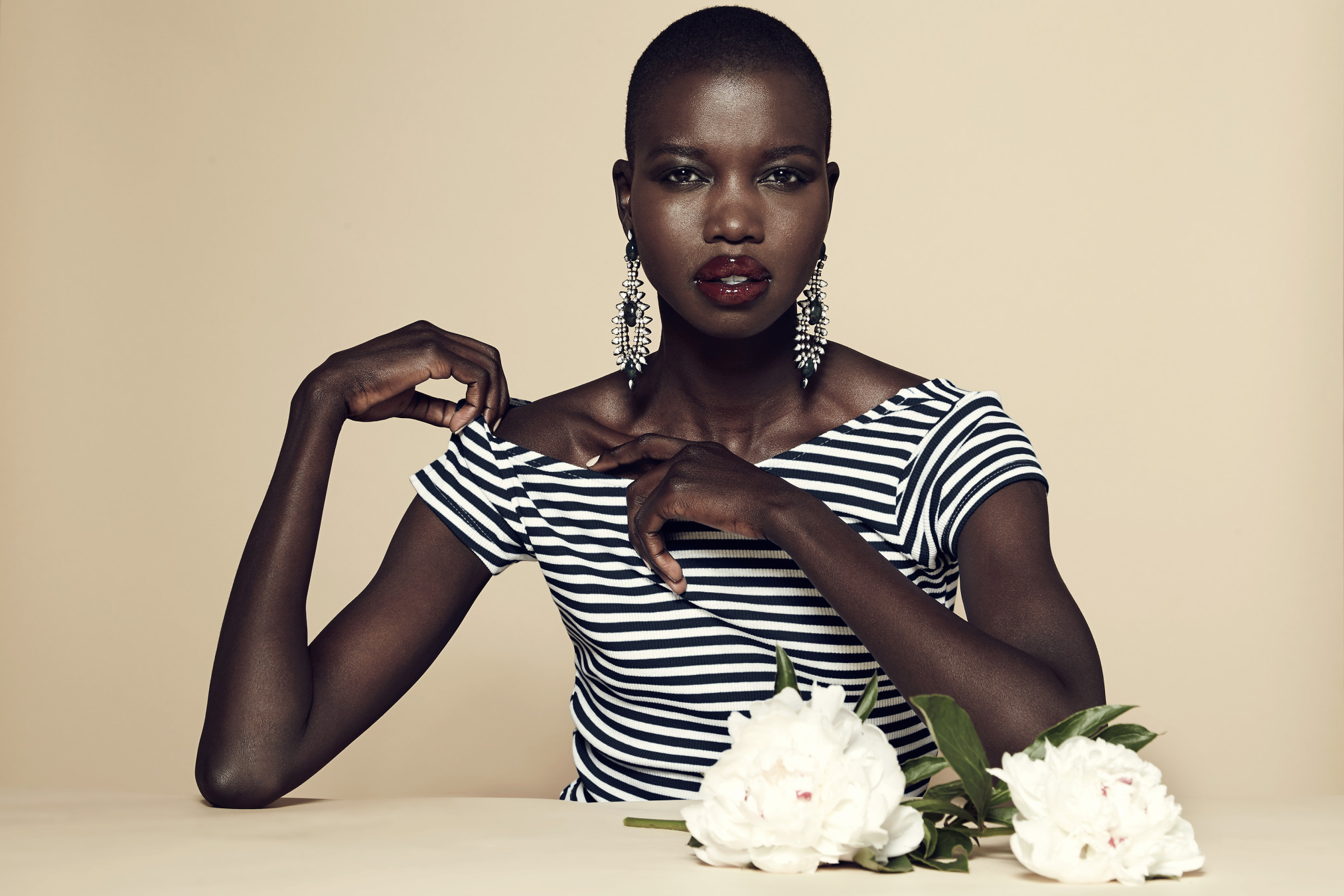
Model to Fashion World: “Stop Making Us Look Ratchet”

putnam flowersphoto from Putnam Flowers

BY CHRISLANDE DORCILUS


Nykhor Paul, a Congolese model and humanitarian, gave the fashion world a stern talking-to over the weekend. She shamed predominantly white fashion houses and makeup artists for one of the more micro-aggressive racist practices common behind the scenes of fashion: not having makeup or hair styling tools that fit black and brown models.

This isn’t the first time that a black model has spoken out about not being fully equipped or supported to do their job. Supermodel Jourdan Dunn has also tweeted comments about how untrained behind the scene staff at fashion shows seem to be when it comes to black skin and hair.

This incident has me dwelling on the nuanced ways that racism affects black women–specially at work. Let’s take modeling as the ultimate example of gendered and racialized labor: women are more likely to get fame and fortune doing it—one of the  few jobs where women can make more than men at all levels of their career. Modeling is also a predominantly white industry.

Nykhor, Jourdan, and other black models make up a very small portion of those being booked in the industry–about 6.8% according to Naomi Campbell. In 2013 this prompted former supermodel Bethann Hardison to pen three letters calling out designers by name for their lack of diversity. Season after season the number of black models has been dwindling. Many in the fashion industry had a hard time pinpointing the problem. The publicist blamed the designer who blamed the casting director who blamed the magazine editors and even still today the buck gets passed around so much that I can’t help but find Hardison’s letter very much relevant. She called it what it was and always will be, “a racist act.”

This form of racism, like all forms of racism, does not cease to function once integration happens. The models that have managed to make it past the policing reality of what it means to be both beautiful and black according to white supremacy, find themselves dealing with another issue: how to be as beautiful as their peers (essentially as good) without the same scaffolding of support available to them.

Imagine getting an office job where everyone had great assistants except for the black coworkers that got sidelined with the incoming interns every quarter. That would be ridiculous wouldn’t it? There’s the hardship of getting the modeling gig–as Nykhor points out black models are few in the fashion industry and then faced with more obstacles of maintaining a gig once booked.

Just as black women in other professional environments have experienced: whether we were ill equipped for specific tasks by an ignorant supervisor, or racist school system. It’s being told to wait for the group and finding that they’d already left–something that’s happened to be throughout my experiences as a black woman, worker, and scholar. The abandonment of both my needs and support by my non-black peers.  It’s all akin to the same feeling of having to represent a group, company, project that never believed in you in the first place. Nykhor cannot do the job of modeling without the art of makeup.  It’s not  fair to her to compete in an environment that is out to make her look “ratchet.” A model with makeup that doesn’t match her skin tone looks idiotic. The long arm of eurocentric beauty standards are accidentally making you look idiotic on purpose. It’s complicated.

Even to those of us that aren’t models and whom are feminist, makeup holds great currency. There are feminist pockets of the internet where talking about contouring and brow pencils is all the rage. Making the self is liberating. Making the self in images that make us feel confident and human is even more liberating. When your job is to represent what it means to be a woman and what it means to be human, finding out that you can’t because of a system that goes out of it’s way to erase your subjectivity and your human needs must be infinitely demoralizing.

At this point, it’s not the makeup companies per se. The higher end brands know that customers of all colors participate in societies impossibly blemish free beauty standards. Nykhor names them in her post – Mac, Makeup Forever, Iman Cosmetics, Covergirl,  Black Opal –  are all companies that cater to the diversity of black skin, all to varying degrees. Don’t applaud the make up industry yet: there are brands like Neutrogena, Physicians Formula, and Almay which, through their actions say, “Black women need not apply.” Racism is a complicated game of economics. And it’s even more in the world where we are told that those of us who are most successful are the ones that can sell a self. Rants like Nykhors ask us to think about how black women have to compete in the world of work and self composing. The quagmire of fighting beauty standards in a world where we can’t even have any.

Nykhor