Marvel Comics is Doubling Down on Diversity

allnewmarvel

By Shanna Bowie

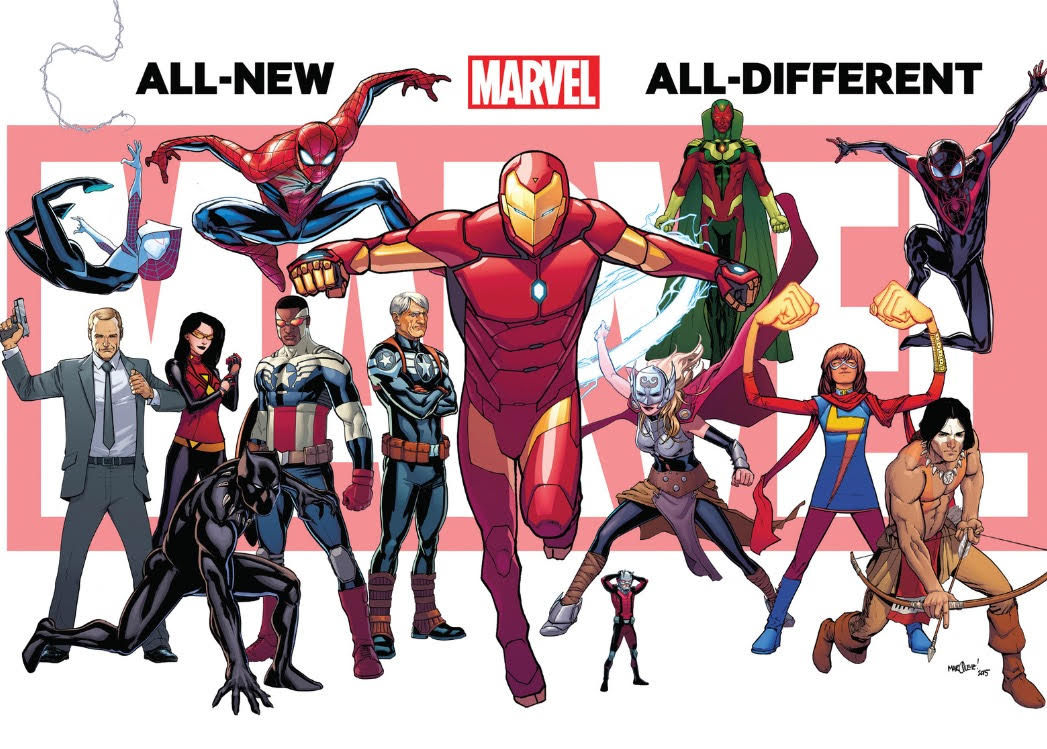
Even though I’m not above criticizing one of my favorite franchises for its shortcomings, I’m also not so petty that I won’t give credit where it’s due. Over the summer Marvel comics engaged in a complete overhaul of its universe with the Secret Wars story arc. The main storyline follows Dr. Doom, his allies and detractors as they try to figure out what happened after the collapse of the two Marvel universes. There have been a myriad of strong titles to come out of this event (believe me when I tell you that my wallet has suffered) and some of the highlights have been A-Force, an all-female Avengers team, Infinity Gauntlet, fronted by a young Black girl named Anwin Bakian and Secret Wars 2099, which features two women of color as Black Widow and Captain America.

And lest this seem like some sort of stunt, Marvel continues to double down on diversity with the announcement of their post-Secret Wars titles. In the All-New All-Different Marvel, there are more than 10 female lead titles, one of which features a pregnant superhero (I have no idea what’s going to happen but I’m excited). With the various superhero team-up titles, all of them prominently feature heroes of color like Miles Morales’ Spiderman and Monica Rambeau. Many of the popular female led titles such as Spider Gwen, Ms. Marvel and Thor are all continuing. As more announcements of new series continue to roll out, Marvel’s commitment to diversifying is evident. Recent announcements include November’s release of Moon Girl and Devil Dinosaur whose star is a precocious, bespectacled African-American little girl with afro-puffs and a pet dinosaur. Also Red Wolf, a Native American character coming out of the Secret Wars’ 1872 book will be getting a solo title in December.

Beyond gushing over what Marvel is doing, let’s talk about what this means. One of the two giants in the comic book industry is not saying that it is committed to diversity but rather diving head first into it. One thing I really give credit to Marvel for is embracing its history and radicalizing it. They are taking characters and racebending and genderbending them without ignoring the ramifications of it. One of the great things about the female Thor is that while she still kicks butt, the other characters openly discuss and address her gender. In the All-New Captain America, Sam Wilson has to defend his right as a Black man to be Captain America. It’s a subversive way to openly address the detractors who complain about Marvel opening up their universe to fully include women and people of color at the forefront. At this point, I’m kind of tithing to Marvel and I admit; I’m a fan. There’s lots of diversity in the smaller comic houses and I will always recommend them to first time buyers but having one of the majors take a running leap towards representing something beyond the standard superhero is affirming. Marvel recognizes that we are here and we want to see ourselves reflected back on the page. And that is empowering.

That Pig Over There

denise_mspiggy

By Shanna Bowie

 The Muppets new show on ABC has picked a winning marketing campaign to draw in viewers. Capitalizing on the popularity of shows like Real Housewives and Love and Hip Hop as well as social media’s apparent love of all things nostalgic, the Muppets have let two important details slip about their new “reality” show about the Muppets lives. At the beginning of the summer, we found out that Miss Piggy and Kermit had ended their decades long relationship. Then a few weeks ago, Kermit was “spotted” with a new lover, Denise, the pig. And the internet lost its mind.

In today’s social media landscape you need two things to succeed; drama and memes. This story has both. First, you have the end of marriage that most people in their 20s and 30s (those folks that advertisers love) associate with their childhoods. It’s like finding out your mom and dad are getting a divorce. Then you add dad’s new girlfriend into the mix. And let’s be real, dad’s new girlfriend is a younger, sleeker version of mom. The streets were hot and the memes were rolling!

It’s a great strategy because in today’s reality television landscape, this is what viewers eat up. We come to watch the Real Housewives of Whereever toss glasses of wine in each other’s faces and the D-list stars of Love & Hip Hop pull out each other’s weave, so in adding that element of personal drama, this show just went from a Muppet-style version of The Office to which pig is gonna get slapped first. It was also interesting to note that while most of these rivalries tend to see fans falling on either woman’s side, many fans denounced mild-mannered Kermit as a womanizer and Black Twitter called out his seeming preference for pigs over other frogs, jokingly likening it to Black men who only date White women. And although Denise has been set up as the stereotypical man-stealing golddigger (one gif shows her pointedly looking at the camera/Kermit and biting her pen), she’s nothing but polite and sweet on her Twitter (yes she has a Twitter account). ABC has created the perfect mash-up of controversy for what was originally seen as an innocuous reboot of the Muppets and the streets will be watching, if for nothing more than to see that TPOT get hers.


The Muppets premiered Sept 22nd on ABC.

Getting the Story Straight

Straight_NWA

By Shanna Bowie

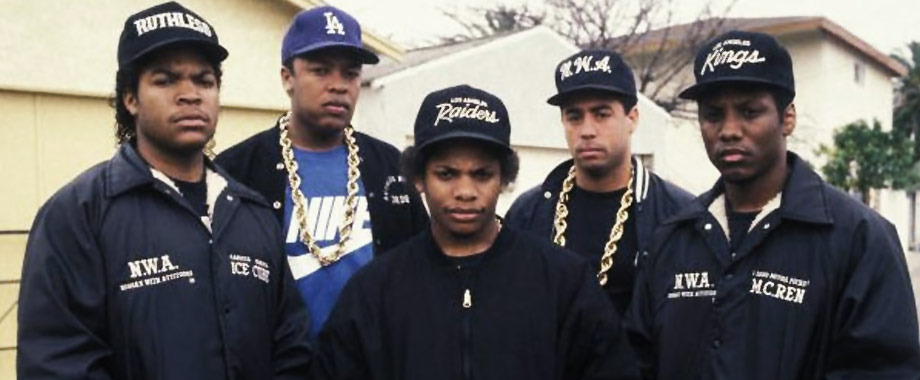
Straight Outta Compton is in theaters and it’s doing amazing. It’s the unexpected hit of the summer. The film, focused on the coming together and rise of the hip hop group N.W.A. (Niggas With Attitude) is receiving accolades for its box office numbers in a climate where minorities are often told our stories won’t win in theaters. And while it’s important to celebrate films like this for their accomplishments, the film also has its detractors, mainly the women who the film whom the film has strategically cut from the film; the women who were domestically abused by one of the groups founders Dr. Dre.  These women and their supporters have been vocal about the abuses of Dr. Dre so I won’t presume to speak over their voices. And Dr. Dre himself after pressure from these women, did apologize for his transgressions. But after seeing the film, what I was struck by was the opportunity Dr. Dre and Ice Cube had to talk about the connection between police brutality and hyper masculinity and how they let that go by in order to save face.

I love hip-hop. I grew up in Brooklyn, N.Y. during Biggie Smalls’ rise and tragic fall. I witnessed the Takeover and the Ether. And my mom probably taught me Rapper’s Delight in the womb. But that doesn’t mean hip-hop is what most black women would consider a safe space. Often hip hop can be a space where Black folks are working out their shit on a very public stage. What made groups like N.W.A. iconic was that they “kept it real” and told what was happening on their streets. The film does a good job in showing that in terms of how it related to over-policing in Los Angeles but sanitized the high-level of misogyny in their music. Much of that misogyny is borne out of the same place. The gangsta persona is a response to knowing you can be slammed onto the hood of a cop car on a whim. The smack my bitch façade is a response to being degraded in front of her. Where Straight Outta Compton failed black women was that in trying to hold up these men as idols, they erased how their very real shortcomings derived from the same place as their iconic music.

Too often women find that they are devalued, abused or erased in hip-hop but we still dance to the music, go up for the artists, and support this music and the men who perpetuate these ideals. We’re the women who don’t want to call the police on our abusive Black men because they’ve already spent their lives persecuted by authorities. But until we speak up about how these problems are interconnected they won’t be resolved. I know Compton was not meant to be a catch all for all of these issues but it was poised at a unique place to address them in an organic way and instead they chose to push a sanitized narrative, which is surprising for the men who once knew “nothin’ in life but to be legit”.

Phoenix : Tammy Bendetti

Headshot2

Tammy Bendetti  lives, works, and drinks too much coffee on Colorado’s Western Slope with her husband and two small daughters. She completed a poetry workshop with Wyatt Prunty at Sewanee: The University of the South, and received a Bachelor of Arts in English Literature from Colorado Mesa University. Her poetry has most recently appeared in Calliope and Grand Valley Magazine, and is forthcoming from Right Hand Pointing. She is currently building a secret room under her stairs but does not plan to keep any wizards in it.


Who is your favorite female identifying written character and why?

Zora Neale Hurston’s Janie from Their Eyes Were Watching God is a force of nature. Just to keep moving after so much hurt and disappointment is admirable. But instead of merely surviving, she keeps shining out love. She’s so full of courage and a willingness to feel everything all the way down to her bones. It’s no wonder Hurston had Tea Cake swallowed by a hurricane, just to give balance. Janie’s heart was swallowing her whole all along.

What literary work by a female identifying writer had the most effect on you as a writer and/or person?

My father used to read to me and my brothers every single night. He didn’t stick to kids’ books, either. We read Lord of the Rings with a dictionary open on the coffee table! When I was seven, we read Anne of Green Gables by Lucy Maud Montgomery. I found it so comforting to think that I could be strange, I could be passionate, I could be very alone at times, and all that could ultimately be an advantage to me. I was an odd duck as a child, and spent a lot of time by myself. If I’d felt compelled to assimilate, I might have lost my voice.

How did your poem Grundy County come about? 

For the first three years of college I attended the University of the South in Sewanee, Tennessee. It’s like a little heaven. Lush green forest and a handful of graceful stone buildings. The teachers are brilliant, the students are engaged, and the sense of community is strong. But it’s a heaven for the wealthy, and I have the debt to prove it. Just next door, Grundy County is one of the poorest in the nation. It used to be home to the Chickasaw and then the Cherokee, which were two of the so-called “Five Civilized Tribes,” “civilized” meaning they cooperated with the U.S. government. The U.S. forced them out, anyway, by the Indian Removal Act in 1830. Native Americans, Europeans, the rich and the poor have been fighting over this bit of land for centuries. All the while, weeds and trees and flowers have been strangling each other for a piece of the same rich soil. One day, after having lived in Colorado for several years, I was washing dishes and looking across the street to the irrigation ditch. The neighbors’ rosebushes were practically climbing through the fence to get to it, and I finally knew what to say about Tennessee.

What has been your greatest writing life moment so far?

 I’m going to cheat and tell you about two moments, because they seem related. An old friend and mentor of mine, Marilyn, is almost always the first to read my poems. She’s super supportive and genuinely enjoys them. I wrote a poem called “In October” last year, and sent it to her. She asked me, “How did you know just exactly how I was feeling today?” In another exchange, she told me she’d shared a few of the poems with someone I don’t know, and that woman was inspired to start writing again after a long hiatus. I’m not likely to become famous. There will always be someone ahead of me. But to make even one person feel seen and important is so gratifying.

What is your favorite piece by another writer from Issue Deux and why?

My favorite has changed at least three times since the issue came out. At first it was “America as a Room,” by Cassandra de Alba, because it feels true and original. Then Amber Atiya’s “everytime I speak, my gums bleed” punched me in the gut. But for now my favorite is “Almost Someone Coming Home.” Alexandra Smyth is some kind of magician. She’s put a whole lifetime in eighteen soft-spoken lines.

What are you currently working on?

I’m trying to find a publisher for a children’s book I’ve written. I lived on an island when I was very small, and I’ve always found the ocean’s rhythm to be the best lullaby. When my first child was born, I knew I wanted to write about it. Children’s book publishing is completely new territory for me! There are things like illustration to consider; I’m an artist, but I’m not sure if my style is the best fit for the story, oddly enough. Plus, how are people going to react if the book does get published, and I continue to swear and write about sex in my poems? People in this country like to pretend that maternal instincts and sexuality are completely antithetical. They DO realize how babies are made, right?

Who/what is your favorite Alice/Alyss?

I really love Alice from Resident Evil. She is saving the world from her own mistakes. And she makes me feel brave.


Disasterrific : Alyssa Yankwitt

AlyssaMichielWedding029_0003

Alyssa Yankwitt is a poet, photographer, teacher, bartender, documenter, and earth walker. Her poems and photographs have previously appeared in Fruita Pulp, Gingerbread House, Penwheel.lit, Metaphor Magazine, Red Paint Hill’s “Mother Is a Verb” anthology, The Lake, Up the Staircase Quarterly, and Spry Literary Journal. Alyssa has incurable wanderlust, enjoys drinking whiskey, hates writing about herself in third person, and loves a good disaster. You can visit her artist page here:https://www.facebook.com/pages/Alyssa-Yankwitt/609514002467835


Who is your favorite female identifying written character and why?

Probably Catherine Earnshaw from Wuthering Heights. She’s such a complicated and complex character, passionate and impulsive. She’s a wild and free-spirit, but I always felt she was struggling to truly be free. Also, her ghost comes back to haunt the man she loved. That’s pretty hardcore.

What literary work by a female identifying writer had the most effect on you as a writer and/or person?

I don’t think I could choose just one.  Three huge influences would have to be: Sonia Sanchez’s, Like the Singing Coming off the Drums, Sandra Cisneros, Loose Woman, and Kim Addonizio’s, What Is This Thing Called Love.

Sanchez’s work affected me due how lush and sensual her poems are. There is such a musicality to her writing, both in sound and on the page, specifically through her use of colloquial language and the way she would use the page as well. Reading one of her poems is like having someone whisper a secret into your ear; that intimate and that important.

Cisneros’ work affected me because of its boldness and bravery. I remember when I first came to her poetry thinking: damn, these are bold and brave poems. There were poems about affairs with married men, about the complicated line between being a female Mexican-American and how her family viewed her as “old maid” because she was unmarried at 30. These poems are from a book titled “Loose Woman.” Cisneros’ words are unafraid and unapologetic. That’s the kind of writer I strive to be.

Addonizio’s work affected me in a similar vein as Cisneros, but it went a step further. Her work too is unafraid and unapologetic but there’s also an edgy grit to it. Reading her poems feels like someone slapped you across the face and then gave you an incredibly passionate kiss. It’s frenzying. But there’s also a delicateness to the poetry; it can break your heart, sometimes two or three times in one poem. Again, this is a balance I try to attain in my own writing.

How did your work/works in Alyss come about?

My poem, “Allen at 25,” came about after the suicide of one of my closest friends. As most suicides are, it was unexpected. A huge bond that Allen and I shared was reading and writing poetry. I found out after that many people didn’t know he even wrote poetry, including his family. They only found out after his death. It took me a long time to write this poem, I think in part because it was also me coming to terms of his actions. It made me wonder what had such a powerful grip on his heart that he couldn’t talk about these important things. Why he couldn’t tell his family about the poems. Why he couldn’t talk about what made him want to end his life.

What has been your greatest writing life moment so far?

I was in a grocery store with a friend and we ran into one of her friends, who worked there. Our mutual friend went to introduce us (and I had no clue who she was) and before the introduction the girl said, “I know you. I saw you read at the poetry reading a few weeks ago.” She then went on to recite her favorite poem I read (which was unpublished), nearly word for word, to me.

What is your favorite piece by another writer from Issue One and why?

Nazia Jannat’s, “Self Portrait for Whiskey Kisses.”  First, because I love whiskey (and whiskey kisses) and second—which I think really sums it all up—is the line “no more ashamed of being ashamed.”

And from Issue Deux?

I am going to choose two. First is Jen Stein’s “Moving Day in April.” I love this poem for its repetition and its sound. And the sound isn’t simply the word choices but the imagery as well. This poem, in the guise of a whisper, is screaming, wailing, singing, and howling. This poem broke my heart in the most beautiful way.

Second would be Merie Kirby’s “At six I wanted to marry Godzilla.” I found it clever and loved all the imagery of water and liquid, from the obvious ocean to the slurping of bowls of noodles and drinking tea. Also, I maybe wanted to have marry Godzilla at one point, too.

What are you currently working on?

I’ve got a couple of chapbooks I’m trying to find a home for. So any publishers or presses who like my work, please feel free to contact me. Yes, I did just shamelessly self-promote.

You can keep up with my work on FB artist page: https://www.facebook.com/pages/Alyssa-Yankwitt/609514002467835

as well as on Instagram: bklyn_chaos

Who/what is your favorite Alice/Alyss?

Well, me of course!


2015 Best of The Net Nominations

We’re super super excited to announce our 2015 Best of the Net Anthology nominations:

Poetry

Darryl Sleeps Through the best sunrise by Lynne Marie Houston

The fly claims no vertigo sitting on the sill by Leslie Rzeznik

For Life by Chrislande Dorcilus

Cellar Violin by Meg Matich

Prose:

Five by Mandy Rose

Worse Things by Taylor Sykes

*nominations are taken from works published during the period of July 2014 through June 2015

Problematizing Our Faves

amypoehler

BY Shanna Bowie

In this day and age, we know so much about our celebrities. Their accessibility is what makes them both appealing and easy fodder for ridicule. One of the biggest problems with our celebrity saturated culture is that it becomes hard to divorce the person from the character they play or the music they make. So what do you do when Robert Downey Jr. says something that would make even Tony Stark cringe?

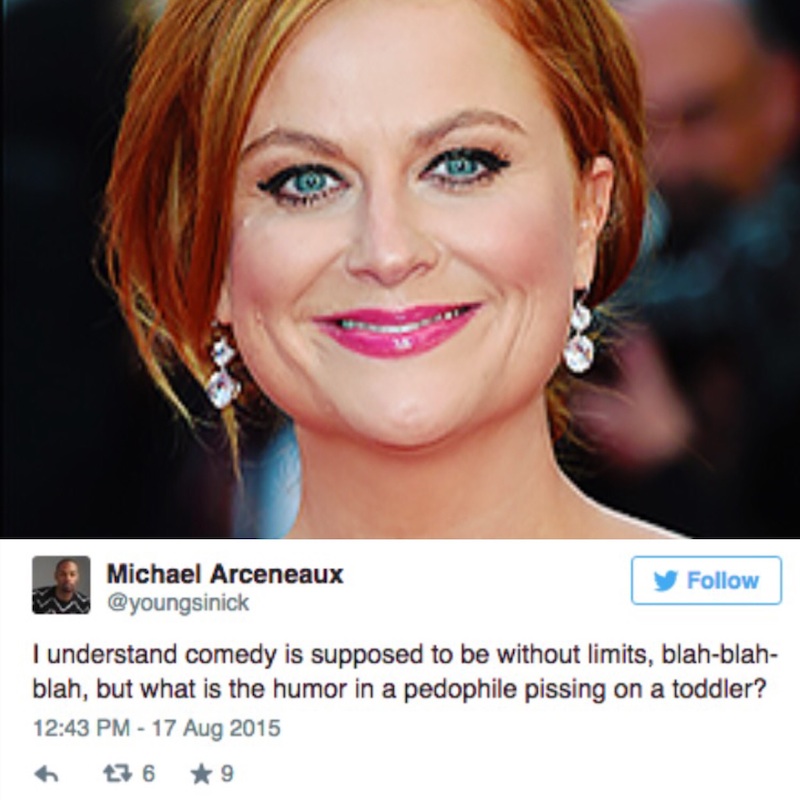
The rise of the problematic fave means navigating how to be a critical fan in a time when it’s more likely that your fave will be problematic. And there’s levels to this ish. Recently, Amy Poehler came under fire because the show she executive produces, Difficult People, made a joke about R. Kelly peeing on Blue Ivy Carter. For some this was just the tip of the side-eye since she’s been called out for being problematic in the past. But for her fans it feels like there’s a choice to make. Do you defend Amy Poehler’s right to make a joke, no matter how insensitive, at the expense of a toddler or do you call out your fave for being in the wrong?

This is the thing, I never want to be an uncritical fan. I can rock with a lot but I never want my love as a fan to be based on whether or not the celebrity that I love (or show or book or author) can say or do anything and I’ll still love them regardless. The truth is that everyone has a line and you can like, love or fan out for someone but also step away or call them out if they cross that line. It doesn’t make you “too sensitive” or “too PC” if you can’t help but look at Anthony Mackie sideways after that “get daddy a sandwich” crack or if you vowed never to buy another John Mayer CD after he talked about having a racist dick. And you can continue to be a fan of someone who is problematic. I think part of being a true fan is acknowledging that your fave is a person, they won’t always be perfect and saying I’m still a fan but this is a place where I think you can do better rather than turning a blind eye to your fave’s shortcomings.

It’s easy to jump on the bandwagon to hate or love a celebrity but when you love them it’s harder to jump off and look critically at what they’re doing. Maybe you’re someone who always wants to keep the work separate from the person, or maybe you have a list of non-negotiables that will make you walk away such as pedophilia and rape (guess who I’m referring to there. No really guess there’s a ton of names). Maybe you don’t want to give up on Joss Whedon because his feminism is one-dimensional or maybe you still have faith that Katy Perry won’t appropriate a new culture in her next video (spoiler alert: she probably already has). Either way, being a fan means navigating where your line is and sometimes it means taking a step back when others have hit their line and letting them vent because we’re all learning and unlearning things and we’re all pretty problematic.


Note: Some of these examples were some of my own problematic faves. The ones who weren’t are horrible and I can’t believe you’re a fan of that guy. 😉

Control

pll_areveal

By Shanna Bowie

“Once there was a man who hated, feared, and loved his daughter’s body so much that he needed to lock it up, control it or destroy it.”

– Jacob Clifton

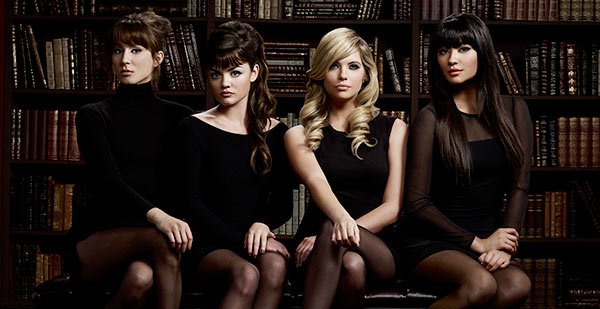
The summer finale of Pretty Little Liars aired last week week and fans are pretty up in arms about the A reveal for a variety of reasons (the psychotic transgender twist, all the questions that weren’t answered and all the A’s that could have been). After the Batgirl comic received a similar backlash over a storyline fans saw as transphobic, I cringed to see PLL headed in the same direction but one of my favorite writers, Jacob Clifton, helped me put this into perspective. At the heart of it, Pretty Little Liars has been a show about five girls whose friendship survives in spite of a world that tells them their friendship shouldn’t exist; that they should compete and fight each other rather than support each other. And in that way A was both a reflection of that world and inextricably caught up in those same forces.

What makes Charles/CeCe’s story so tragic but also so very relatable is that every woman has had to navigate those same forces. We discover during the finale that Charles ended up in the Radley sanitarium not because he was a danger to Ali as we thought but because of his gender non-conformity and its danger to the image his father wanted to portray. After Charles is finally able to realize his dream of becoming CeCe, she continues to struggle with isolation from her family and after dealing with her father’s rejection, her mother’s lies and a life in a psych ward, CeCe plays out her revenge on these girls in whom she sees the same qualities. As Clifton writes:

That shame and loneliness are a self-reinforcing feedback loop that only creates more shame and more loneliness, turning any attempt at a roman à clef into a picaresque. And that the system is designed for that purpose: To keep us separate, vulnerable, afraid and ashamed, because if we ever started talking to each other about it we would start a fucking riot.

And even as the finale ends with a jump five years into the future, we see the Liars caught in that same loop they thought they’d escaped. I also don’t think it’s a coincidence that so many of this summer’s shows with strong female leads have similar themes. In Humans and UnReal, which I’ve previously discussed, we’ve seen artificial intelligence as a metaphor for bodily control and also how women play out societal misogyny on each other. So much of what can make Pretty Little Liars frustrating (the never-ending parade of men dating these teen girls, the feeling like we’re repeating the same patterns, the specter of menace that doesn’t always payoff) is also what makes the overall point of this show.

There are always those guys that hover and seek to control and take advantage. We do repeat those patterns again and again and the sense of menace does follow us (and occasionally make good on its promise). While the A reveal may have been clichéd or “problematic” it was also always the way this story was headed.


*All quotes used with permission. For more information of author, recapper Jacob Clifton, please check out jacobclifton.com


CRYBABY : Straight Outta The Dollhouse

StraightOuttaSomewhere

By Amanda Faye

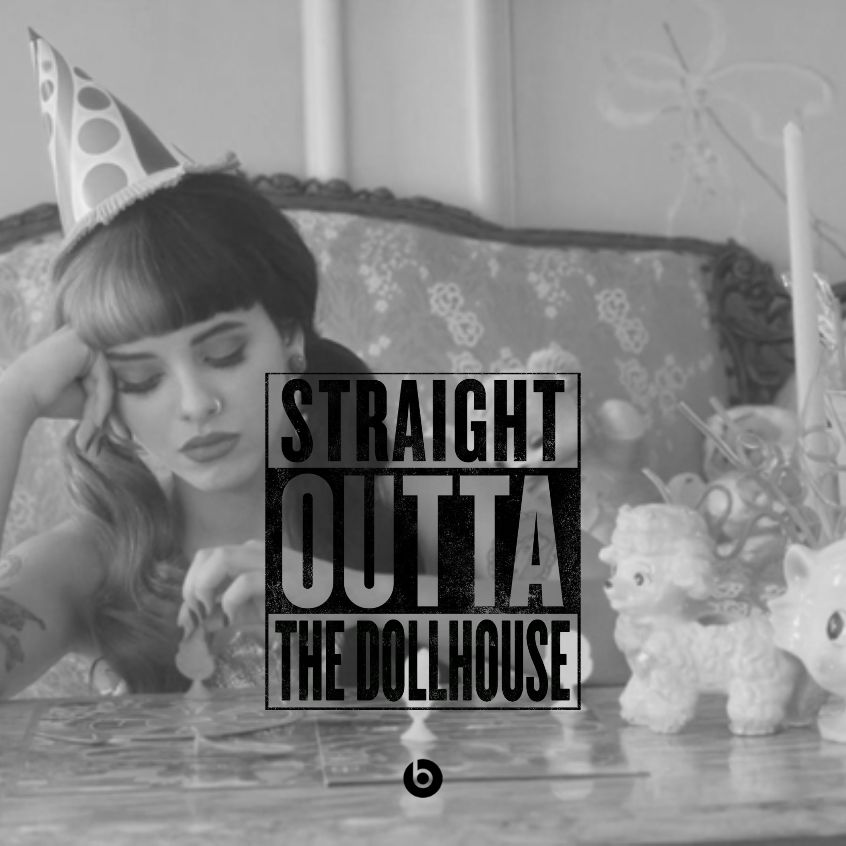
Twitter is great for a lot of things: knowing which celebrity just left our realm, watching twitterfeuds escalate while eating spoons full of biscoff, giggling at the latest Directioners-fueled trending topics and, at the most dire of times (which seems to be at least once a week), keeping abreast of tragic world events and important protest movements. It’s also pretty ace at introducing new music, which is how I discovered Melanie Martinez’s new album CRYBABY, whose tag happened to be trending the same day poor Perrie Edwards had her mid-performance breakdown.  Reading tweets of lyric quotes by Martinez’s fans got me intrigued.  I’m pretty sure Pete Wentz is somewhere brooding over the fact he didn’t come up with some of her lines; Martinez has writing credits on 12 of the 13 songs on the standard version of CRYBABY.

I’ve never been happier to go down a twitter trending hashtag rabbit hole. The album is wonderfully caustic and catchy at the same time. The songs tackle not so happy and carefree issues like sexual assault, adultery, mental illness, and dead babies by pairing these anything-but-light lyrics with glittery electro-pop music. I actually found myself singing along with the song “Tag, You’re It,” not registering the implications of the lyrics until the third or fourth listen. It’s basically every woman’s nightmare who’s ever been aggressively cat-called while walking down the street – a story about being physically assaulted by a random male. #YesAllWomen

CRYBABY was conceived as a story surrounding the title character Cry Baby and her far from enviable romantic endeavors. I’m not generally a fan of concept albums (unless they result in Gerard Way dressing up in a marching band uniform while leading the bleakest parade EVA!)  but this one works.  Cry Baby seems like the type of chick I’d love to have on speed dial for those I-need-a-happy-hour girls meet-up days.  She’s been through some things, dated some losers, but she gets that “all the best people are crazy”.

Top 3 from the album:

Pity Party:

The first time I heard Leslie Gore’s “It’s My Party,” it became my favorite song OF ALL TIME.  The first time I heard Melanie Martinez’s “Pity Party,” which samples “It’s My Party” for the chorus, it became my second favorite song OF ALL TIME.  An exaggerated “whatever” has been my go-to snarl whenever I hit a wall of disappointment I can’t smash through, and after hearing this song I’ll be adding “just means there’s way more cake for me” because who doesn’t love cake?!?  Not me. I love cake. If this song were cake it’d be a Black Forest cake full of cherries and whipped cream topping.

Sippy Cup:

The music on this track is so mellow and low key, which is a perfect counterpoint to the far-less-soothing lyrics:

He’s still dead when you’re done with the bottle

Of course it’s a corpse that you keep in the cradle

Kids are still depressed when you dress them up

Syrup is still syrup in a sippy cup

The video that goes with the song is equally intense– it shows Cry Baby discovering that her alcoholic mother has murdered her husband and his mistress:

Alphabet Boy

We’ve all encountered that one guy who just insists on mansplaining to us something (anything really) in a condescending manner.  Now we have a song to sing in our heads while we pretend to listen:

I know my A-B-C’s

Yet you keep teaching me

I say fuck your degree

Alphabet boy

You think you’re smarter than me

Cartoon Style: Dressing up to the funnies with Bojack Horseman

suit needs more flasks

By Chrislande Dorcilus

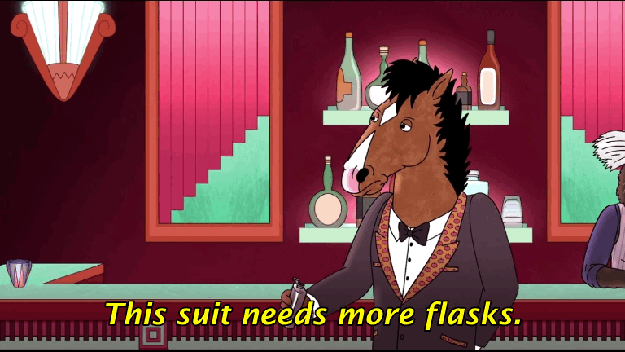
I don’t have cable, so netflix is a constant source of entertainment for me, and combined with the fact that my live-in boyfriend is an aspiring animator, I had no choice but to watch Bojack Horseman when it came out in 2014. I’m the kind of woman-child that watches a whole season of American Dad when I am regenerating from a mild depression just because the characters are paper and their problems are in 2D. So, I instantly fell in love with the talking horse from “Horsin’ Around” and his cohort of eccentric characters from the infamous Hollywoo.

My most favorite thing about the show is the fashion. During her REDDIT AMA Lisa Hanawalt, Bojack Horseman’s character designer, exclaimed,I love drawing crazy animals and weird clothes.” And boy is she great at it! Characters are dressed based on both their personality and geography. There wardrobes are also time and period specific when necessary. You’re probably wondering why that matters. Fashion is important part of rendering a believable imaginary world where women play an active social and political role. As a series that star women comics like Lisa Kudrow and Amy Sedaris (Princess Caroline), Show’s creator Raphael Bob-Waksberg wanted to move away from comedy’s focus on masculinity and maleness to showcase female characters being/doing funny things i.e this lady croc in crocs.

croc in crocs

As fashion is an important part of women’s personal and professional lives, it is important for shows, movies, and even animations to portray not only how they bring us together, but how they divide us. What Sextina Aquafina, the pop star dolphin, can wear on stage is very different than what Princess Caroline, the middle aged talent agent, can pull off–in both the context of the show and society at large.


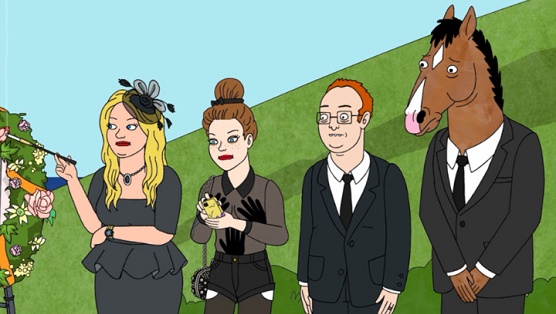
This image is a scene from a funeral. Look at the two female characters. See how their outfit denote their age and personal sensibilities, and notice how that contrast with the drab suits worn by the male characters. It speaks volumes about gender, and self expression. The limits of what constitutes as formality for men are both sobering and sad.

BoJack-Horseman-Still-Broken

Now, check out Princess Caroline’s funeral appropriate cocktail dress with the wide grid mesh shoulders contrasted with Mr. Peanutbutter’s tuxedo tracksuit. It helps to interrogate the freedoms and power dynamics at play when there exists social situations which some people feel complete comfortable dressing informal and other do not. Can’t you just read their power and place in Hollywoo’s social scene? Look at the detail in Henry Winkler’s tie. I gag and die for Hanawalt’s subtlety.

Herb's Funeral PC MR PB


Though an animated comedy, Bojack’s story does stand on a very serious foundation that grounds us through important questions about sex, gender, self, friendship, love and even substance abuse. We explore the morality of a deranged horse/man who finds himself in the sticky ambivalence of his fame. This life involves costume changes. From high fashion cocktail events to days spent drinking in Boxers, we become intimate with the character by realizing that they too wear themselves.